The Gospel Truth
By Vikram Murthi
Disclosure Day
Dir. Steven Spielberg, U.S., Universal
“Well, I guess you’ve noticed something a little strange with Dad,” says Roy Neary (Richard Dreyfuss) through tears to his frightened family in Steven Spielberg’s Close Encounters of the Third Kind (1977). After experiencing brief contact with a UFO that leaves a burn on his face, Roy exhibits increasingly erratic behavior, compulsively crafting models of a mountainous shape that has invaded his subconscious. His mania emotionally terrorizes his wife Ronnie (Teri Garr) and three children, who eventually abandon him once his prolonged breakdown compels him to dig up their garden in a bathrobe. Roy undergoes something akin to a spiritual awakening that to most cognizant observers resembles a complete mental collapse.
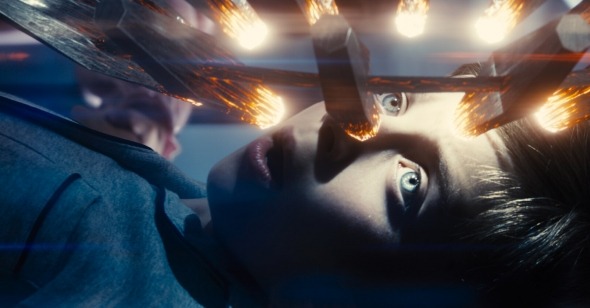
The closest analog to Roy in Spielberg’s new science-fiction film Disclosure Day (2026) is Margaret Fairchild (Emily Blunt), a TV meteorologist whose life becomes upended after coming into contact with an alien before she goes to work one morning. Upon staring into the eyes of a red cardinal that flew into her apartment, Margaret can suddenly speak multiple languages and read people’s minds, a talent she uses to offer advice to people in various degrees of emotional distress. When she goes live on air to deliver the weather, she begins speaking in gibberish before collapsing. Her sudden change in behavior disturbs her coworkers and her doofus boyfriend (Wyatt Russell), who, not unlike Ronnie, just wants everything to go back to normal.
The only person who understands what Maragaret says on the broadcast is Daniel Kellner (Josh O’Connor), a former employee of the clandestine extra-governmental organization Wardex who has stolen their troves of data proving the existence of alien life. Margaret’s newfound intuition drives her to search for Daniel, whom she senses has also been touched by the same otherworldly presence. Together, they venture towards a group of Wardex defectors, led by the dulcet-voiced Hugo (Colman Domingo), who wish to publicly disclose the truth about extraterrestrials to the entire world. Meanwhile, Wardex head Noah Scanlon (Colin Firth) and his cronies are on their tail so as to conceal that information believing it will only further destabilize a globe on the brink of an extinction-level war.
Despite its galactic stakes, Disclosure Day forgoes loud spectacle for more subdued drama. The action setpieces (e.g., a car chase on train tracks), the use of fantastical alien technology (psychic control, bilocation, invisibility), and even John Williams’s score take on a muted, contemplative quality. If anything, Spielberg’s latest resembles an existential chase film, like if The Sugarland Express (1974) had a therapeutic streak. The focus lies largely within the heads of Margaret and Daniel, who, much like Roy and his fellow experiencer Jillian (Melinda Dillon) in Close Encounters, are compelled towards each other in search of answers to larger questions about their place in the universe. How are they connected? Why do they feel so misunderstood by those around them? Did someone, possibly from above, briefly enter their lives and profoundly change them?
Across Spielberg’s films, aliens have frequently been a vehicle to explore religiosity from a secular perspective. Institutions and dogma are elided in favor of dramatizing the ecstatic feeling of believing in something far beyond one’s station, and having that faith rewarded. His wayward protagonists search for meaning in the cosmos to clarify the senseless world below. Spielberg invokes the divine when the childlike aliens emerge from the spacecraft in Close Encounters as well as when the eponymous extraterrestrial from E.T. (1982) makes his first appearance. The hyper-advanced androids at the end of A.I. Artificial Intelligence (2001) with the power to grant emotionally devastating wishes resemble celestial beings. Even the vaporizing aliens in War of the Worlds (2005) inspire awe, just not the good kind, befitting its post-9/11 Bush-era cultural context.
In more ways than not, Spielberg’s foundational blasphemy lies in his belief that evidence of aliens trumps everything from domestic stability to the confirmation of God’s existence. (Even the crystal skull in Indiana Jones and the Kingdom of the Crystal Skull [2008] isn’t a connection to the civilization of Akator but rather proof of interdimensional beings.) In Disclosure Day, the near-octogenarian director partially interrogates this perspective through the character of Daniel’s girlfriend Jane (Eve Hewson), a former novitiate who believes that disclosing documentation of aliens would only undermine the faith-based community amidst international strife. How would theology survive if we could actually lay eyes on “supreme beings”? Spielberg provides a brusque response when Margaret, after realizing she’s a vessel for alien communication, tells a deaf, wonderstruck former Wardex employee that she refuses to be anyone’s religion.
Ironically, Jane’s creed not only puts her in league with the likes of Wardex, whose interests are tied up in national defense and corporate propriety, but also makes her a target for exploitation. In a particularly nasty scene, Noah uses an interplanetary device to prey on Jane’s piety and manipulate her into betraying Daniel; she tries squeezing a cross so tightly she bleeds to ward off his advances, but ultimately fails. Even after Jane escapes Noah’s mental clutches, she later asks for guidance from her mentor Sister Maura (Elizabeth Marvel), who gently informs her that the Bible never precludes the possibility of otherworldly life. It’s as if Spielberg himself is asking for absolution for the most resonant motif of his career.
**
Disclosure Day fascinates as an auteur object. Margaret, Daniel, and Jane’s tour (or, escape) through the Midwest features many signifiers of Americana in which Spielberg has previously trafficked: farmhouses, diners, highways, hospitals, etc. A misguided authority figure with vague governmental backing serves yet again as a primary antagonist. Attentive viewers will spot not-so-subtle nods to his previous works. The tactile technology in Wardex’s corporate headquarters and Noah’s clairvoyance both recall Minority Report (2002). Spielberg attempts his version of the trainwreck sequence from The Greatest Show on Earth (1952) that baptized himself and his fictional stand-in in The Fabelmans (2023) in cinematic destruction. The film’s final act, a dramatization of a live breaking-news broadcast, evokes the (inter)national urgency embedded in The Post (2017).
Spielberg often imbues his characters with a sense of bewilderment as a means of audience identification. Neither the viewer nor the characters in the film is prepared to believe, say, sharks are feasting on unsuspecting children, or what the Ark of the Covenant actually contains, or that dinosaurs can walk amongst us. Spielberg foregrounds this emotion in Disclosure Day whenever Margaret showcases her psychic abilities for compassionate ends, like encouraging a cop who pulls her over for speeding to forgive his tired wife or urging a harried coworker to leave an abusive relationship. Multiple people, including Margaret, repeat variations of “I don’t know what’s happening” in a mixture of fear and reverence as they process the unbelievable in real time.
That same perplexed, quasi-religious feeling ideally would reflect the viewer experience, even as Spielberg and cinematographer Janusz Kamiński work in tandem to deliver their patented blend of hyper-backlit, spatially precise drama. But while Disclosure Day provides a lot to ponder and admire, especially for devotees of Spielberg’s oeuvre such as myself, it doesn’t inspire the type of astonishment that characterizes his strongest work. Its diffuse, breakneck narrative, courtesy of screenwriter David Koepp, isn’t nearly as involving as it should be, mostly because the eventual triangulation of Margaret, Daniel, and the former and current Wardex workers is so telegraphed from the jump that too much of Disclosure Day feels like marking time. Admittedly, Blunt’s possessed performance—one of, if not the best of her career—does its damndest to infuse Disclosure Day’s weakest moments with an appreciably off-kilter energy.
Moreover, Disclosure Day’s storytelling inadequacies aren’t appropriately compensated by its emotional gambles. A late scene featuring Hugo gently leading Margaret and Daniel to remember the details of their shared alien abduction from childhood—framed by Spielberg in a deliberately unreal fairy tale context, positioning both kids as a version of Hansel and Gretel—should feel cathartic. Spielberg even ties it to the revelation that Hugo and his team have spent much of the film reconstructing Margaret’s childhood home on a soundstage to trigger the release of her repressed memories. An act of communion, fostered by a community invested in the care of relative strangers, underlined by the inherent tragedy that no one can ever return home again—this is where Spielberg excels. Yet, the entire sequence feels oddly impersonal and flat, with certain touches, like a young Margaret holding a young Daniel’s hand to soothe his fears, coming across as distant instead of intimate.
On paper, a heady remix of ideas and themes first introduced in Close Encounters modified for the present moment should burrow under the skin. [Plus, Disclosure Day hardly suffers in comparison to Spielberg’s 1977 masterpiece since it’s operating in different modes towards comparable yet ultimately dissimilar ends.] Spielberg’s fundamental optimism about the unknown still holds considerable sway to me, especially as the nation regresses further into xenophobia. The landmark image from Close Encounters of the young Barry looking out his front door at a UFO’s blazing orange light might suggest danger, but crucially, the child isn’t afraid. In fact, he beckons the unseen beings to come inside. In Disclosure Day, this message takes on a literal dimension through Margaret’s initial unintelligible broadcast, which we learn translates to, “Don’t be afraid of what you don’t know.”
This unfortunately prosaic dimension of Disclosure Day becomes difficult to ignore as it veers towards the concluding sequence its title promises where Spielberg and Koepp’s political limitations are on full display. While their updated ’70s-era governmental distrust is on point—Spielberg even revamps Close Encounters’ corrupting image of the Piggly Wiggly truck containing military equipment into a meat processing plant housing malicious Wardex employees—their belief in the primacy of images to sway minds, let alone suspend an indistinct international conflict, feels too naïve to swallow. It’s a noble fantasy I would like to believe in, but it simply fails to translate, even as Spielberg’s direction of the titular disclosure impresses, complete with an archival tour of major UFO conspiracies dating back to 1947, and the accuracy of such a phenomena being mediated through a sea of smart phones.
The opening shot of Disclosure Day features a wrestler’s foot stamping on Kaminski’s camera. Spielberg detractors will have a field day connecting the image to George Orwell’s famous Nineteen Eighty-Four (1949) quote, “If you want a picture of the future, imagine a boot stamping on a human face— forever.” The Hollywood titan’s cultural supremacy, and his longtail impact on the film industry, will probably always feel somewhat authoritarian to his critics, with his preternatural ability to pull the masses’ heartstrings serving as a cheap distraction from his cinematic hegemony.
Debates over Spielberg’s influence on American cinema aside, his sentimental streak—still perceived by some as a deficit, no matter how complicated it appears on screen—has actually accumulated potency as society’s atomization continues unabated. His enduring faith in flawed people (as opposed to benevolent, beatific extraterrestrials) to still be invested in our collective survival, in the face of overwhelming odds and irrefutable evidence, feels more humane than we frankly deserve. In Close Encounters, Spielberg goes to some lengths to underline that Roy Neary isn’t the only person undergoing a concerning, spiritually induced crisis; in fact, he's one of many searchers desperate to discover why the night skies have affected them so deeply. For all of Disclosure Day’s shortcomings, Spielberg makes a very similar case with Margaret’s saintly counsel: she touches people by telling them what they already know but are afraid to confront, demonstrating that we’re all connected by the wounds we carry. Spielberg’s insistence that “we are not alone” was never meant as a threat but a form of reassurance.